How To Buy Property In Islamabad From Abroad – Guide For 2026
Covers how to check approval by CDA or RDA, verifying ownership, viewing a property remotely, power of attorney, paying with Roshan Digital Account, and taxes under the Finance Act 2026.
It is completely possible to buy property in Islamabad from Saudi Arabia, the UAE, Qatar, the UK, or North America. Many overseas Pakistanis do this every year. However, being a long way away means you are unable to do the checks you would normally do locally, such as physically visiting the plot, viewing at the society office, and reviewing the original file.
The solution is not to find a ‘reliable dealer’ but to set up a process to make sure all key elements of the deal (approval, ownership, who the money will go to, and transfer) can be verified.
This guide shows you exactly what to do to buy residential plots, houses, or apartments in Islamabad and the surrounding Rawalpindi. This guide has been written based on rules and enforcement in place as of October 2026. RDA refers to the Rawalpindi Development Authority throughout. The Roshan Digital Account will be written in full or Roshan account, to avoid confusion with the State Bank.
Key Takeaways
- Check the legitimacy of the scheme and the authority. CDA are proactively pursuing unauthorised schemes including sealing off offices in 2026. They have also released lists of illegal housing and agro-farming schemes.
- Just because it is authorised doesn’t mean it is owned by them. Even authorised societies may have a plot that is contentious or double sold. Double check the plot and seller.
- Use an independent inspector. Do not solely rely on photos/drones from the seller!
- Limit the power of attorney. You can use the NADRA online platform to sign a PoA remotely however having a wide PoA can be very risky.
- Ensure payments are made using verified and traceable options. Using a Roshan Digital Account can ensure there is a documented trail in and out.
- Ensure tax status is checked prior to transfer. All filers will pay a fixed rate of 1.25% (Buyer) and 2.75% (Seller) advance tax from 1 July 2026. Non Residents who hold NICOP/POC and qualify may receive the filer rate even if they haven’t filed.
Why Purchasing From Overseas Can Pose Different Risks
Remote purchasers will have specific areas of risk that should be mitigated.
| Risk | How it typically happens | Control |
| Unapproved scheme | Marketing implies approval; no LOP or NOC exists for the phase sold | Check the authority’s official records and notices yourself |
| Fake or disputed ownership | Seller is not the recorded owner, or the plot is sold to several buyers | Written confirmation from the society or record office; lawyer review |
| Misrepresented site | Footage shows a different or developed plot | Independent inspector, live video, location matched to the layout plan |
| Misdirected payment | Payment is sent to a personal account or an altered bank detail | Verify beneficiary through a separate, official contact channel |
| Over-broad PoA | Representative can sell, mortgage or transfer beyond the purchase | Specific, lawyer-drafted PoA limited to this transaction |
| Tax surprise | Wrong filer status or valuation basis at transfer | Check status and notified value before agreeing the price |
| Repatriation surprise | Assumes sale proceeds can be sent abroad at any time | Read your bank’s property investment terms before buying |
Step 1: What are You Buying and Why?
You need to know what tests to apply if you’re purchasing land as an investment or as a home for your family.
Home for your family: Look into schools, medical provision, public roads, utilities, and realistic build times. Land that is cheaper may not be feasible if it is in an area that is still only planned.
Capital growth: Compare the asking price to recent similar completed projects. Not other ads. Look into how far along development is, ease of access, legal status, and likely demand. A new society, airport location, or new road announcement does not mean it will increase in value.
Rental Income: Work out how much you could realistically expect to earn from the property. Once you’ve subtracted maintenance costs, void periods, management fees, and taxes. High yields are not always a good investment if the property is left vacant.
Write down your budget, what type of property you want, how long you want to hold the property for, and whether you will be living in, renting out, or selling. This will also help you decide if you care about future repatriation of profits (see step 6).
Step 2: Who Owns the Project? Is it approved?
This is the most important thing to check. Don’t pay a penny before checking.
- Projects will often be marketed under an Islamabad name but can be owned by CDA, RDA, or other authorities. Find out who actually owns the land and check if it is approved. Check what phase/block it is.
- CDA housing schemes: https://www.cda.gov.pk/housing-schemes
- CDA property lookup tool: https://www.cda.gov.pk/onlinePropertyVerification
- CDA illegal housing: https://cda.gov.pk/illegal-housing-schemes
- RDA private housing: https://rda.gop.pk/private-housing-schemes
LOP and NOC are different. In private schemes within CDA’s jurisdiction, there are two documents required: Layout Plan (LOP) and No Objection Certificate (NOC). These are not completion certificates. One phase doesn’t mean another phase, extension, or neighboring block will be approved.
Enforcement is real and current. There is real risk of enforcement. Under the CDA Ordinance 1960, ICT Zoning Regulations 1992, and 2023 regulations for private schemes in Zones II, IV, and V, a private sponsor cannot plan, market, launch, or develop a scheme unless approved by the CDA. The CDA has released lists of almost 100 illegal housing and agro-farming schemes. In September 2026 there were press reports of CDA ordering the site to be sealed and marketing offices closed for a scheme in Zone IV (D), which had developed land without an approved layout plan and NOC. Notices were put up in 2025 and 2026. CDA also ordered service providers to only connect services as per approved layout and building plans.
As an overseas buyer, you could run into issues. The land may be enforced and may never have legal utilities connected. It may also be difficult to transfer or sell. And you’ll be thousands of km away from the issue.
Double-check what property you are being offered. If details aren’t available online, ask the authority for confirmation in writing.
Step 3: Who Actually Owns the Land?
Even if the scheme is approved, there is no indication that the person selling you the land can legally sell.
Ask for documents including:
- Allotment/Transfer letter. Full transfer history.
- Identification for the seller and proof they can sell.
- Original ownership/title documents.
- Plot number, size, block, and position on the approved layout plan.
- Current ownership for the society. Any outstanding dues.
- Any mortgage, charge, litigation, or transfer restrictions.
If someone is acting under a power of attorney, make sure they have been verified by the authority. Ask the official office of the society to confirm who the property is registered to, any outstanding dues, if it can be transferred, and if there are any restrictions. If it is owned by a land revenue/registration authority, consult a lawyer to see what documents and process to follow to find the correct records for that parcel of land.
Plot or File? These terms can be used interchangeably in the market. A file doesn’t necessarily mean it is an actual plot of land. It could just be a booking, membership, etc. Ask for confirmation in writing of what you are actually buying. Don’t pay the plot price for a file.
Photocopies, screenshots, WhatsApp pictures and verbal confirmation from seller isn’t proof of ownership.
Step 4: Request an Independent Inspection
Photos and videos will not give you any idea of the property’s boundaries, current state, and legal status. If you are unable to visit in person, get someone who has no vested interest in the sale to visit. This could be a relative, a lawyer’s representative, or a professional surveyor.
Ask them to confirm:
- The access point, including the road and how a typical visit would work.
- The plot is in the correct location as per the approved layout plan.
- Any inhabited properties nearby, under construction, or existing infrastructure.
- That the electricity, water, sewerage, and roads are functional. Not just plans.
- The plot can be accessed physically.
You will want to have a live video call so that the person can show you that they can identify their surroundings and the access. If purchasing an apartment or house, then they should also look inside the property, utilities, maintenance, and occupancy.
If the seller is unwilling to allow a reasonable independent inspection, then you should stop here and do more investigations.
Step 5: Use a Limited Power of Attorney
A Power of Attorney (PoA) allows someone in Pakistan to act on your behalf. They can submit documents, visit the society/registration offices, and complete certain aspects of the transfer. It is one of the most commonly abused documents used in property fraud, so you need to ensure that it is limited.
Executing a PoA from abroad. Power of Attorney executed from abroad. NADRA, in conjunction with the Ministry of Foreign Affairs, has a Power of Attorney service available online for overseas Pakistanis. This was launched in November 2021 and can be found here: https://poa.nadra.gov.pk/. You will need to provide your valid NICOP/CNIC/POC. Then fill in your attorney and witness details. Upload your document, complete the biometric verification, and pay the required fees. You will have a video interview with a consular officer. Once approved, you will print off the receipt and post it along with your original PoA to your attorney in Pakistan. The document can still be manually attested at the mission. Fees and processes will vary between missions. Please check the website for your local embassy/consulate in Pakistan.
To limit any risk:
- Use someone you know and trust.
- Get a Pakistani lawyer to create or review your PoA.
- Be specific with your property and transaction.
- List exactly what they can do.
- Don’t allow them to sell, mortgage, or gift the property unless you genuinely intend to.
- Check with the society/registrar that they will accept the PoA and what format they want.
- Formally cancel the PoA once the purpose is complete.
- Some authorities may require extra verification.
Please note that some authorities will require further verification. Please make sure that you have checked the appropriate office for these requirements.
Step 6: Moving Money
All transactions need to be traceable and linked to any agreements and must go to a verified recipient.
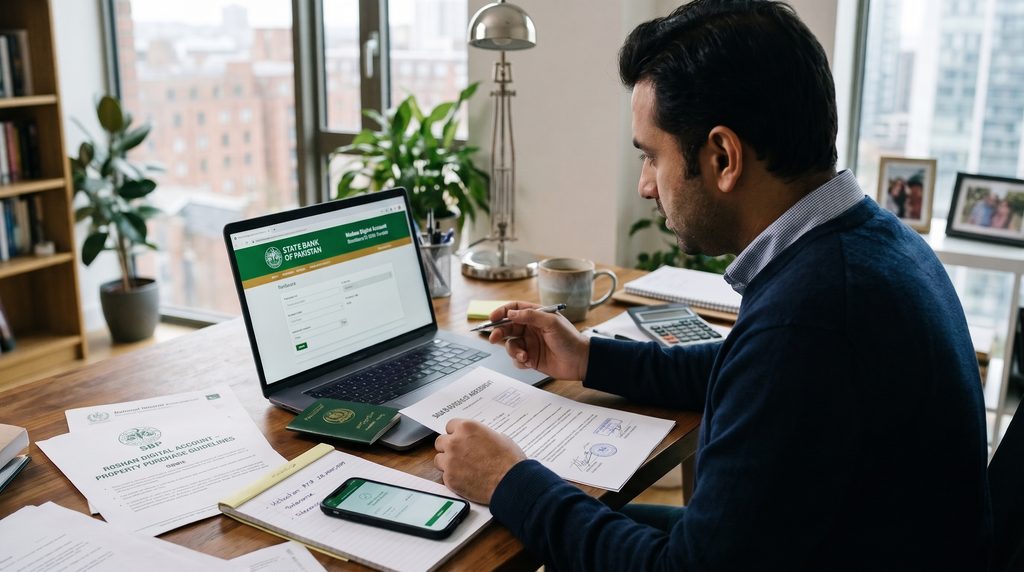
Using a Roshan Digital Account
The State Bank of Pakistan provide a Roshan Digital Account which allows eligible non residents of Pakistan to create an account. They will allow property purchases through the eligible NRPs Rupee Value Account (NRVA). There are a number of banks with published terms to show how this can work in practice. Usually there will be terms such as:
- Funds must be deposited via a bank transfer either through remittances or from your own value accounts.
- Payment must be made to the developer/seller via a payment order, banker’s draft, or electronic payment.
- You will be required to provide a copy of the sale/purchase agreement or letter from the housing authority. You may also be required to provide valuation reports from independent valuers.
- The price paid should be within the tolerance (as one bank states 10%) of the average of the independent valuations at the point of investing and when disinvesting.
- You will be required to provide proof of tax and duty payments and eventually a title deed in your name. This should be provided within the timeframes (one bank states 30 working days for the tax and duty and 6 months from final payment for the title deed).
- Rental income can be received into the account; however, you must follow the bank’s rules.
Worked example of the valuation tolerance: if there are 2 independent valuations averaging PKR 20,000,000 and the bank has a 10% tolerance, then the price agreed should be between PKR 18,000,000 and PKR 22,000,000. If it is outside this range, then the bank will not allow you to invest through this route.
Repatriation needs reading, not assuming. Whilst the banks have published terms showing that usually you will be able to repatriate funds held within a Roshan account, there can be more specific rules regarding repatriating the proceeds from the sale of property. For example, one bank states that after 3 years the entire amount can be repatriated; however, the difference must be invested into other eligible instruments. You will need to ensure that you have provided all the documents required. The terms vary between banks and can change, so it is best to contact your bank for up-to-date written guidance prior to purchasing if you are concerned about repatriating funds in the future.
It is not a legal requirement to use a Roshan account for all purchases. Not all accounts and funding routes will be applicable for all transactions. For official information, please visit https://www.sbp.org.pk/our-operations/roshan-digital-accounts and https://www.sbp.org.pk/faqs/faqs-roshan-digital-account.
Before Every Payment
- Ensure you can verify the true legal name and account of the person you are paying by using a source not provided in the payment request.
- You must be sure that the person you are making the payment to is authorised to sell or that it is the official account for the developer.
- Be sure that the payment is made against the agreement, invoice or approved schedule.
- Keep a record of the confirmation from your bank and official receipt(s). Ensure you know how the payment has been applied to your plot.
If there is any unexpected change to the details of the beneficiary, stop payments and confirm directly with the organisation.
Never redirect payment to a personal account because a dealer says it is faster.
Step 7: Calculate the Full Cost and Your Tax Position
| Cost Category | What To Confirm |
| Property price | Agreed amount and payment schedule |
| Federal advance tax | Section 236K (buyer) and Section 236C (seller), and who bears them |
| Stamp duty and registration | Charges for the property’s location and the instrument used |
| Transfer charges | Society or authority transfer fees |
| Outstanding dues | Society dues, utility bills, other liabilities |
| Legal review | Document verification and agreement review |
| Representative costs | PoA, attestation, courier and administrative expenses |
| Ongoing costs | Maintenance, service charges, management |
Not every item applies to every deal. Request a written breakdown from the society or authority.
Advance tax after the Finance Act 2026
The Finance Act 2026, which came into effect on 1 July 2026, changed the filing rates to a fixed amount. It also removed the additional rate for late filers. Active Taxpayers List: taxpayers in 2027 will pay the following amounts:
- Buyer, Section 236K: 1.25% of fair market value
- Seller, Section 236C: 2.75% of the consideration
Non-filer rates are substantially higher. Published reports differ on the exact non-filer figures, so confirm them with FBR or a tax adviser before agreeing a price.
Illustration (PKR 20,000,000 plot, both parties on the Active Taxpayers List, taxable value equal to price):
| Item | Calculation | Amount |
| Buyer advance tax (236K) | 1.25% of 20,000,000 | PKR 250,000 |
| Seller advance tax (236C) | 2.75% of 20,000,000 | PKR 550,000 |
The taxable amount is whichever is highest between the notified value and the price paid. You cannot lower the value in the deed. ICT have notified new valuations, (SRO 163(I)/2026) replacing (SRO 2392(I)/2025). Additional costs are stamp duty, registration and society.
Overseas Pakistanis
According to the FBR’s overseas FAQs, the filer rate will apply to overseas Pakistanis for Sections 236C and 236K advance taxes. This applies to non-filers, who have a POC or NICOP, and are non-residents. This means you were only in Pakistan for less than 183 days. The process must be done through the registering authority. A payment slip will be generated through the ‘Overseas Pakistanis’ link on FBR. The commissioner will verify the status and documents. Only then can you pay the filer rate.
This concession is dependent on a few factors; if you become a resident by going over the cutoff, this does not apply. Just because you are living overseas doesn’t mean you get every concession available. Please ensure you can qualify and have the right documents to do so. https://www.fbr.gov.pk/overseas-faqs/174240/174248
If you are looking to make a profit on resale, please also consult with a tax advisor about capital gains. This depends on when you originally purchased the property and what your status is.
Step 8. Check the Agreement
A good agreement should include:
- Correct identification of the parties
- Full description of the property, including plot number, block number, size, and phase
- Total price and method of payment, including amounts and when due
- What documents will be provided by the seller and how the title will be transferred
- Who is responsible for any outstanding dues, taxes, and charges?
- What happens if there is a default refund policy and cancellation details? Dispute resolution.
Clarify the consequences of not making a payment on time, having delays, and having transfer issues. Don’t sign any blank forms and ensure you don’t agree to any main points only discussed in chat. Get a lawyer to check through any agreements before any major payments are made.
Step 9: Finalize the Transfer & Maintain Your Own Records
The last payment made doesn’t mean that it’s fully transferred legally. This will depend on if it’s transferred via the housing society, land authority, or registration office. If it is land that needs to be officially registered, then refer to the following guidelines from the ICT Administration: https://ictadministration.gov.pk/registration-of-deed/
Before you think it’s finished:
- Confirm the correct process with the relevant office.
- Provide original documents and ID (through your attorney if needed).
- Pay the pre-emptive taxes & fees and obtain the receipt.
- Obtain the Transfer Confirmation / Registered Deed / Current Owners.
- Check that it is showing the correct buyer, plot, and information.
- Keep a copy of all agreements, receipts, POAs, and bank records.
Step 10: After You’ve Bought the Property
If it is an empty property, ensure that regular checks are carried out and that there is a method for reporting any issues. If it is to be rented out, ensure that you have a written rental agreement in place. Ensure you keep records of the money received for rent and who will deal with carrying out repairs. If it is an undeveloped plot of land, ensure that you are keeping track of how the development is progressing. Ensure that you keep your contact details up to date with the society so that you are aware of any payment due dates and official correspondence.
A Recommended Sequence for Remote Buyers:
| Stage | Action |
| 1 | Define purpose, budget and holding period |
| 2 | Identify the governing authority and check scheme approval and notices |
| 3 | Verify the specific plot, the seller and any dues |
| 4 | Commission an independent inspection |
| 5 | Check filer status, valuation and the full cost |
| 6 | Open and fund your Roshan account, if using that route, and read its property terms |
| 7 | Have a lawyer review the agreement; execute a narrow PoA if needed |
| 8 | Pay in stages against verified documents and receipts |
| 9 | Complete transfer and obtain the official ownership record |
| 10 | Store records and arrange ongoing oversight |
Red Flags for Overseas Buyers
- Unable to provide details of the approving authority or the scheme is not present in official records or appears as illegal.
- Urgent payment, limited time offers or promise of guaranteed returns.
- Unwillingness to have a third party or official check.
- Payment into personal accounts or last minute changes to your account details.
- File sold with a plot reference or plots with references that cannot be matched to an approved layout.
- Requests for wide ranging or general Power of Attorney.
- All documents are only provided as copies, screenshots or via chat.
- A price that is significantly lower than other plots with no clear reason.
Common Mistakes to Avoid
- Do not pay without checking they have permission to sell. Confirm their legal status.
- Just because a scheme has been approved does not mean the plot will be approved. It may only be for certain stages/areas.
- Do not rely solely on your dealer; get independent legal advice and check directly with the authority.
- Do not give a wide-ranging power of attorney. Only provide what is needed for the transaction.
- Keep records of all payments made. Keep bank statements, agreements, and official receipts.
- Not all overseas Pakistanis will be eligible for the same tax rules. Eligibility depends on your ID, residency, account type, and current legislation.
- Do not rush into a purchase. Take time to look at the documents and compare options.
- Do not expect guaranteed returns. Prices can go down, and developments can take longer than expected.
Frequently Asked Questions
Yes, in most cases. With an authorized representative, certain steps can be completed by using a properly executed and accepted power of attorney. This will vary depending on the property and transferring authority and attestation requirements.
Using the NADRA POA portal, you can apply with a valid NICOP/CNIC/POC. Complete your biometrics, pay fees, and do a video interview. Or alternatively complete manual attestations at your local mission in Pakistan. Requirements will vary depending on your mission and the fees involved.
No, it is optional. As long as you are eligible, you can use the relevant account. There are certain conditions set by the bank to ensure that you can make allowed real estate investments with your account.
This will depend on how you are funding, what account you are using, and what the bank’s conditions are for property investment. Some have publicly available conditions stating that you can fully repatriate the funds from your property sale after a certain time with all documents in order. Speak to your bank to find out their current conditions.
You can look up the CDA records to see if the scheme is approved in Islamabad, or look up the RDA list to see if it is approved in the relevant area of Rawalpindi. Ensure you are looking at the correct phase and any public notices. If unsure, ask for written confirmation.
Not always. Non-residents who are eligible can be charged advance tax (Section 236C & 236K) at the filer rate, despite them being non-filers. This is done through an FBR facility requiring approval from the commissioner. You should confirm with FBR or your tax adviser if you are eligible.
Only if you have confirmed they are legally able to accept the money. Ensure you know who the beneficiary is by using official contact details. Ensure you get a proper receipt.
Not always. This depends on how the property is owned. Contact the society/authority directly or a property lawyer to confirm who owns the property, if it can be transferred, and what documents are needed.
Final Checklist Before You Commit
Check that the authority is correct and that the scheme has been approved for that specific phase and block.
- Check the illegal scheme list and notices of the authority.
- Confirm the plot, position on the approved layout, and what rights are being sold.
- Have ownership documents and dues checked by an independent professional.
- Arrange for an independent survey (with live video if possible).
- Check who you are paying by using an independent method.
- Understand the total costs, taxes, and whether you are a filer/overseas.
- Read through the agreement and any power of attorney with a lawyer.
- Check repatriation clauses if you wish to take the proceeds abroad.
Know what official documentation will be provided to show the transaction is complete.If any answer is unclear, pause until it is resolved.
Conclusion
Purchasing property in Islamabad can be easily achieved if there are written documents to make sure you are making decisions based on evidence. It puts you in a stronger position to know that you have independent verification, limited power of attorney documents, transparent payment, a clear understanding of tax and repatriation, and clear documentation to transfer. Discipline is key due to the distance.
Note: This article is provided for general information purposes only and should not be considered as legal, taxation, or investment advice. Rules, tax rates, valuations, bank conditions, and processes change frequently. Please verify with the relevant authorities within Pakistan, your bank, and professionals that you are aware of the current requirements.
Official Sources
- Capital Development Authority: housing schemes, online property verification, illegal scheme lists (cda.gov.pk)
- Rawalpindi Development Authority: private housing schemes (rda.gop.pk)
- Federal Board of Revenue: overseas Pakistanis FAQs on Sections 236C and 236K (fbr.gov.pk)
- NADRA and Ministry of Foreign Affairs: online Power of Attorney portal and mission consular pages (poa.nadra.gov.pk, mofa.gov.pk)