
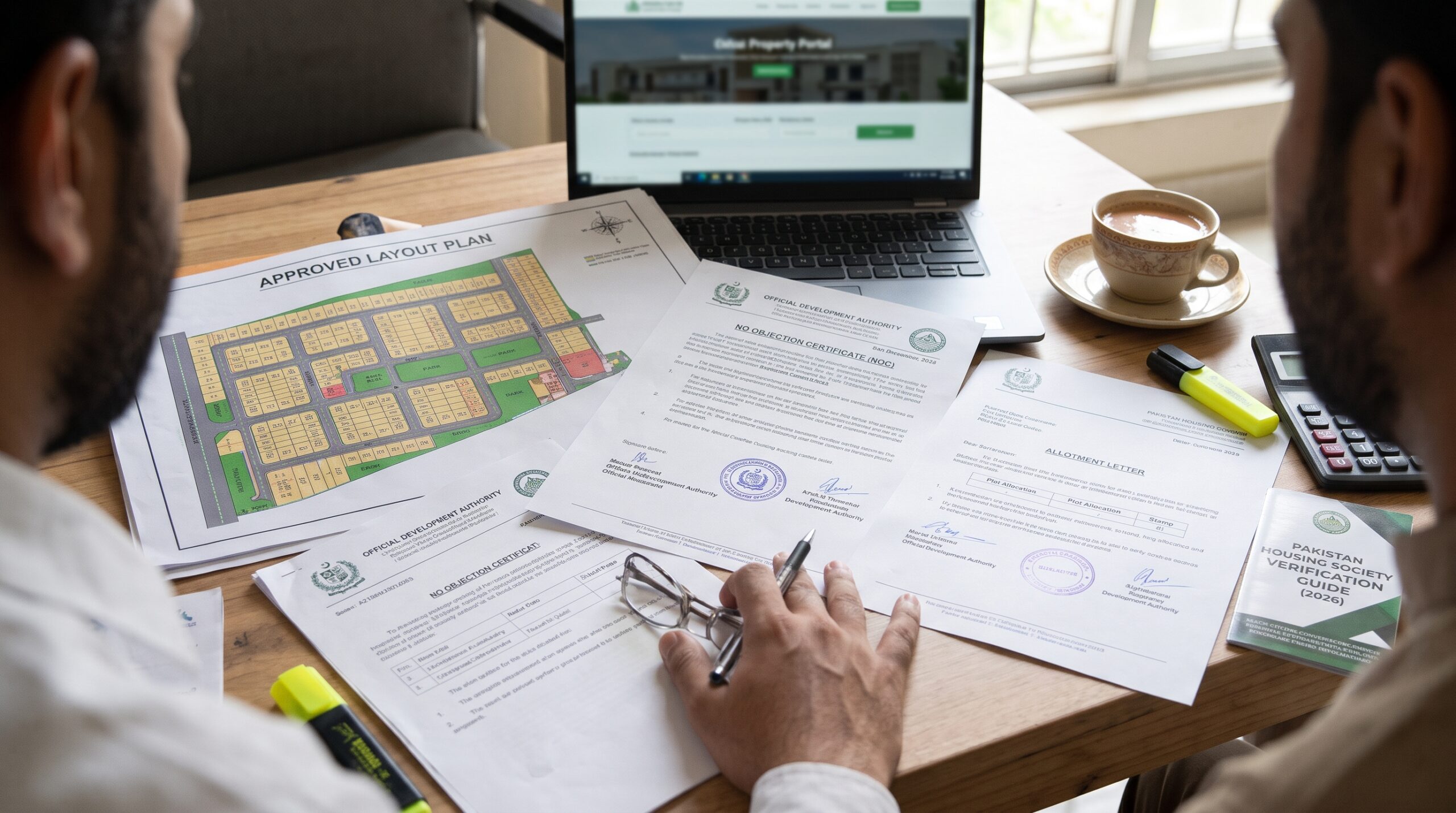
How to Read a Housing Society’s NOC, Layout Map and Allotment Letter in Pakistan (2026)
This guide draws on the CDA’s published housing‑scheme records, current regulations, recent RDA enforcement notices and a step‑by‑step verification method that buyers in Islamabad and Rawalpindi can use.
Most disputes over plots in housing schemes do not start with a forged stamp. Instead they start when a buyer trusts a document to prove something it was never meant to prove. An N‑C‑O tells you that the scheme has received approval. A layout map shows how the approved land is divided. An allotment letter records that a sponsor or society has given a plot to a person. Each of these documents answers a question and none of these documents answers all of the questions.
This guide explains what each document establishes, what this guide does not cover, how to cross‑check the three documents, against one another and which office can confirm each fact. This guide follows the CDA’s published description of its approval system the status labels that it currently displays and the enforcement activity reported in 2026.
Key Takeaways
- Three documents, three questions: The NOC is about approval the layout map is about planning. The allotment letter is about allocation. Read all three together.
- CDA does not check allotments: CDAs own housing-schemes page says that allotment and transfer of plots in schemes are done by the sponsors without any check or help from CDA. An NOC from CDA therefore cannot prove that a seller’s allotment letter is real.
- LOP and NOC are steps: CDA gives Layout Plan (LOP) approval then gives an NOC for development after more steps and later gives a completion certificate. Its public list shows scheme statuses that mix these steps in ways.
- Approved scope is the test: In September 2026 the RDA reportedly sent show-cause notices about plots that were supposedly being sold in blocks, outside an approved layout plan. Compare the block and area you are offered with the approved area.
- Check with the office that issued the document, not the seller: Use the official records the group that registers the society and a property lawyer who is independent.
Who Controls Which Part of the Document Chain
| Function | Institution | What It Covers | What It Does Not Cover |
| Planning and development approval for projects in the field of information and communication technology | Capital Development Authority (CDA) is a city planning body that deals with development and I have seen it in action. | LOP approval, development NOC, completion certificate and building control all relate to schemes. LOP approval is the step. Development NOC is needed to start work. Completion certificate confirms that the project is finished. Building control ensures safety and quality in schemes. | Individual plot allotments and transfers which the CDA says are managed by sponsors |
| Registration and management of co-operative housing groups in the field of information and communication technology | Deputy Commissioner / Registrar, -operative Societies ICT Administration is a key official who manages cooperative societies and ICT matters and I respect the work that they do. | Registration, elections, AGMs, allotment or auction of plots and audit are all governed by the -operative Societies Act 1925 and Rules 1927. Registration is the step. Elections decide the board. AGMs are meetings.. Auction of plots determines who owns the land. Audit checks the records. | Planning approval of the layout |
| Controlling private limited companies | Securities and Exchange Commission of Pakistan (SECP) oversees the securities market. Ensures fair trading practices and I find this important for investors. | Corporate affairs of company-owned schemes involve managing the business side of the project. Corporate affairs include contracts, finances and compliance. Company-owned schemes are managed by the team. | Planning approval plot, by plot title |
| Private housing projects, in the Rawalpindi area | Rawalpindi Development Authority (RDA) focuses on development projects, in Rawalpindi. I appreciate the community efforts of Rawalpindi Development Authority (RDA). | NOC and approval, under the Punjab framework are required for any development. The Punjab framework sets the rules. NOC is a no‑objection certificate. Approval confirms compliance. | ownership and transfer records |
| Title and transfer of land at the plot level | Society, sponsor records, land-record and registration offices are the places where you can find documents. Society, sponsor records, land-record and registration offices are worth checking. | Who holds the plot. On what terms is an important question. The owner of the plot is the holder. The terms describe how the plot can be used or sold. | Scheme approval |
The practical lesson: approval comes from the development authority, but the allotment record sits with the society or sponsor. You must verify each at its own source.
Quick Overview: What Each Document Tells You
| Document | Main purpose | What to verify | What it does not prove |
| NOC | Records the authority approval for the scheme or the phase that it names. | Issuing authority, reference, date, scheme and phase name, area approved, conditions | That any specific plot is real free of issues or sold to the person |
| Approved layout plan (LOP/map) | Shows the approved land use, the blocks, the plots, the roads, the parks and the facilities. | Approval details, revision, plot number, size, land use, boundaries | That the roads, parks and buildings shown on it have actually been constructed |
| Allotment letter | Records that a plot was given to a named person, under the process. | Allottee, plot details, payments, dues, transfer terms | Registered ownership or that the plot is located in a permitted area |
1. How to Read a Housing Society’s NOC
An NOC is a document issued by a competent authority stating that it has no objection to the matter described, subject to the conditions stated. For private schemes in Islamabad, the competent authority is CDA. For schemes in the Rawalpindi region, it is generally the RDA.

Check These Six Details
- Issuing authority: The issuing authority must be the authority that has jurisdiction over the land. A letter from the developer, a marketing company or a society is not an authority NOC.
- Reference. Date: Write down the reference number and the date. Quote them when you contact the authority. Even a looking certificate still needs confirmation.
- Exact scheme name, phase and extension: Compare the scheme name, phase and extension on the NOC with the names on advertising booking forms and sale papers. Similar names are common.
- Approved. Boundaries: Compare the approved land area with the area the developer advertises. Marketing can describe a project than the one the authority approved.
- Current status: A document can be. Cancelled after it was issued. Check the authoritys record, not just your copy.
- Later notices: Read the conditions and search, for notices, restrictions, cancellations or show‑cause letters.
Reading CDA’s Status Labels
CDAs public housing-schemes list shows the zone, road, area in kanals and separate LOP and NOC status for each scheme. I looked at the page on 29 October 2026. Noticed that the LOP field had values such as approved, provisional approval and cancelled while the NOC field had values such as issued, not issued, cancelled and in one listing approved. Different combinations. Each carries a different meaning, for a buyer.
| Combination Shown | What It Generally Signals | Buyer Response |
| LOP approved, NOC issued | The layout is. The development NOC has been issued for the area that is listed. Layout approval signals that the project can move forward. | Proceed to verify the plot, phase, ownership and dues. |
| LOP approved, NOC not issued | The layout is approved,. The development NOC has not yet been issued. Layout approval alone does not mean the NOC is ready. | Treat as approval. Ask CDA in writing what remains and do not pay as if it were complete. |
| LOP provisional approval, NOC not issued | Layout approval is provisional. Layout approval could change if new information comes to light. | Seek written clarification of the status and what it permits. |
| LOP approved, NOC cancelled | An NOC was. Sought, but NOC was later cancelled. Cancellation of NOC means the project cannot proceed until a new NOC is obtained. | High risk. Obtain CDAs written position before any payment. |
| LOP cancelled, NOC not issued or cancelled | Layout approval has been withdrawn. Layout approval stops the project from moving | High risk. Do not proceed without written confirmation, from CDA. |
| NOC field blank or differently worded | Record is incomplete or inconsistently labelled. Record makes it hard to verify the status of Layout or NOC. | Do not assume approval. Contact. Ask for the status in writing. |
Two cautions:
- First the labels belong to CDA. The page can change. Therefore check the record and the schemes own detail page instead of relying on a screenshot.
- Second a status listed on a list is not an opinion. If the position matters to your decision ask CDA to confirm it in writing and then have a lawyer interpret it.
How RDA Approval Looks, in Practice?
RDA publishes lists of approved and illegal schemes on its website and advises the public to verify status there instead of relying on promotional material. RDAs 2026 enforcement shows why the scope of approval matters:
How RDA Approval Looks in Practice?
RDA publishes lists of approved and illegal private schemes on its website and advises the public to verify status there rather than relying on promotional material. Its 2026 enforcement shows why the scope of approval matters:
• In July 2026: The RDA issued show‑cause notices to the owners and chief executives of thirteen schemes. The RDA said that the owners and chief executives had carried out development, booked plots and advertised them without permission. The RDA referred to Section 12(5) of the Punjab Development of Cities Act 1976. Rule 4 of the Punjab Development Authorities Private Housing Scheme Rules 2021 to back its claims.
• In September 2026: The RDA issued notices about alleged marketing and booking of plots that were not part of a scheme’s approved layout plan and about alleged marketing that did not have the required NOC. The RDA listed the approved area for each scheme in kanals. Told the public to check the status on its official website. The sponsors of the schemes may dispute these allegations. I included this example to show what the checks are, for.
Does an NOC Mean Every Plot Is Safe to Buy?
No. An NOC does not confirm who owns a plot, where the plot is located whether paymentsre complete or if the plot can be transferred. It might cover a portion of what the sponsor promises. Consider it one step in your due diligence, not a promise that everything is clear or safe, from fraud or disputes.
2. LOP, NOC and Completion Certificate: Three Separate Stages
CDA explains a two-step approval for schemes. First the Layout Plan (LOP) must be approved. Then after some formal steps a No Objection Certificate (NOC) for the scheme development is issued. CDA also issues a Completion Certificate when the work matches the approved layout plan the design of services and the specifications. The current rules are the Regulation for Planning and Development of Private Housing/Farm Housing, Apartments and Commercial Schemes/Projects, in Zones 2 4 and 5 of ICT, 2023. This regulation was announced as S.R.O. 886(I)/2023 on 7 July 2023 under the ICT Zoning Regulations 1992.
| Stage | What It Generally Tells You | What It Does Not Establish By Itself |
| LOP approved | The authority has approved the layout of the scheme. The plan is now ready for the next steps. | That the development NOC has been issued |
| NOC issued | The authoritys record shows that the development NOC has been issued and all paperwork is complete. | That every plot is owned by the seller or free of dispute |
| Completion certificate | The development was certified complete, within the certificates scope meaning the project is fully approved. | That every individual allotment or sale record is correct |
If a salesperson says that the LOP is approved and that the NOC is also approved ask for the authoritys record of both the LOP and the NOC. CDA also notes that following the 2018 directions from Islamabad High Court CDA manages building control in housing schemes through two directorates of building control. For a buyer who plans to build that means that construction in a scheme is subject, to CDA building control, which is another reason to confirm approval status early.
3. How to Read the Approved Layout Map
A layout map tells you where the plot should sit in the planned scheme. Brochure maps, social‑media maps and sales‑office models are marketing tools, not the approved plan.
Step 1: Identify the Approved Version
Look for the scheme name, approval reference, approval date, revision number and any official endorsement. If the map you are shown differs from the authoritys record ask which one is the approved layout map. A newer looking map does not automatically mean the layout map is an approved revision.
Step 2: Compare the Marketed Area With the Approved Area
This is the check that most buyers skip. Find the approved area in kanals on the authoritys record then compare it with the area the developer advertises and with the blocks being sold. Blocks, phases or extensions marketed outside the approved extent are the risk in the 2026 enforcement examples above.
Step 3: Locate the Exact Block and Plot
Find the block, street and plot number from the allotment letter on the approved layout map. A dealer pointing at an area does not confirm the location. Ask the societys office to confirm the plots position against its records.
Step 4: Check Size, Dimensions and Land Use
Compare the plot size in the allotment letter with the approved layout map and the societys records. Note the frontage, depth and the road width in front of the plot. Confirm the designated land use because a plot shown as commercial, park or amenity space is not freely available for construction. For a high‑value or disputed plot commission a survey.
Step 5: Read the Surroundings
Examine plots, roads, parks, commercial plots, drainage routes and public facilities. A planned road, park or school on a layout map does not prove that the road, park or school has been built.
Step 6: Ask About Revisions
Ask whether the plots number, size, location or land use has changed since approval. If a seller refers to a revised plan, a shifted plot or a replacement plot request the documentation and verify it with the authority. An informal explanation, for a mismatch is not an answer.
4. How to Read an Allotment Letter

An allotment letter is a document that shows a plot has been given to a person or organization through the issuer’s process. The legal strength of this letter depends on the rules of the scheme the rights involved and other related records. It should not be seen as a registered title deed.. Should it be treated as proof that a resale can happen without further verification.
Since the CDA says it does not verify allotments or transfers in schemes the office that confirms these matters is the society or sponsor. For -operative societies, in ICT the confirming authority is the Registrar of Co-operative Societies. For company-owned schemes it is the SECP-regulated company records. A lawyer can help you figure out which process applies in your case.
What to Check
| Item | What to Confirm |
| Allottee’s name | Matches the identification documents and the societys record. For inherited or transferred plots check the documents that establish the holders rights. |
| Plot number and block | Matches the approved layout map and the societys record. |
| Size and category | Identifies the plot type—commercial, farm or other—and confirms it matches the map. |
| Date and reference | Appears in the issuers records. Has not been cancelled, replaced or superseded. |
| Payments and balance | Original price, instalments credited, balance and late charges—confirmed in a current statement, from the issuer. |
| Transfer conditions | Resale permissions, transfer fees, possession and construction conditions—verified. |
| Signatures and stamps | Authenticity confirmed with the issuing office not by appearance. |
If the Seller Says the Original Is Lost
Do not think it is not true but do not forget the danger. Ask the society to check the recorded allottee the condition of the document the method to get a duplicate and if there is any conflict or rule that stops transferring. Let a lawyer look at the situation before you give any money.
5. Cross-Check the Three Documents Side by Side
| Detail | NOC | Layout Map | Allotment Letter |
| Scheme name | Confirm | Confirm | Confirm |
| Phase or extension | Confirm approval scope | Match approved version | Match plot record |
| Approved area | Compare with advertised area | Compare block with approved extent | Not applicable |
| Plot number | Often not listed | Locate the exact plot | Confirm |
| Plot size | May give overall area only | Check dimensions | Confirm recorded size |
| Reference | Check issuing authority | Check approval and revision | Check letter number and date |
| Ownership | Not proof | Not proof | Verify with society and relevant records |
| Transfer status | Does not settle it | Does not prove eligibility | Confirm current status and restrictions |
Not every document contains every detail. The goal is to decide which source confirms each fact and resolve any inconsistency through the right office.
6. A Verification Workflow You Can Follow
- Identify the authority: Determine if the land is governed by CDA, RDA or another body.
- Find the scheme on the list: Open the scheme’s record. Note LOP and NOC status, zone, area and any notices.
- Match the scope: Check that your phase, block and extension are inside the approved area.
- Request the approved map or extract: Get it from the authority or the society’s official office not from the dealer.
- Verify the allotment: Ask the society’s office, the Registrar of Co‑operative Societies or the company’s official records to confirm the recorded allottee, dues and transfer eligibility.
- Get it in writing: Ask each office to confirm office’s answer, by letter or email.
- Have a lawyer review: The set before any token or advance is paid.
Questions putting in writing:
- What are the current LOP and NOC statuses for this scheme, phase and extension?
- What is the approved area. Is this block within that area?
- Is plot number X in block Y located as shown on the approved layout plan?
- Who is the recorded allottee. Are there any outstanding dues, legal disputes or transfer restrictions?
- Is the allotment currently transferable. If so, on what documents?
7. Warning Signs That Deserve Further Investigation
- A single missing detail does not prove fraud. Unexplained discrepancies are a reason to pause.
- The NOC number cannot be verified with the issuing authority.
- The advertised phase, block or extension does not match the approved area.
- Only a marketing map is offered and the approved plan is refused.
- Plot number, size or block differs between documents.
- The allotment letter names another person and the transfer history is unclear.
- The society will not confirm the allottee or outstanding dues.
- Payment is requested into a personal account.
- You are told approval is almost complete. Asked to pay as though it were granted.
- Pressure to pay before the documents can be checked.
- The scheme appears with a cancelled or not-issued status or, on an illegal-scheme list.
- The right response is to pause, get written clarification and take legal advice.
8. Worked Example: Three Documents, One Mismatch
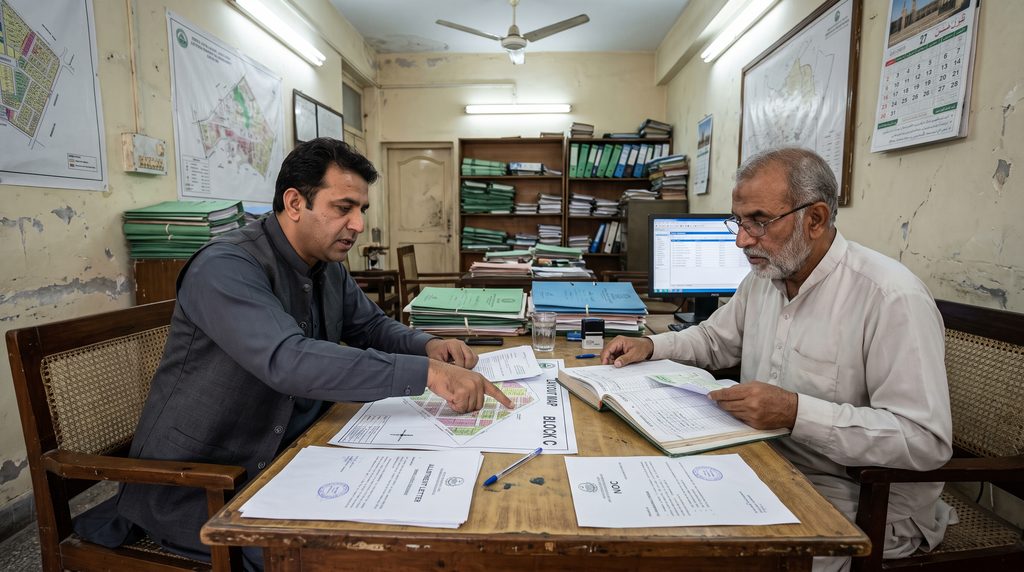
A buyer is given a plot in Block C of a private scheme. The seller gives the buyer a NOC that names the scheme a layout map that shows Block C and the plot number and an allotment letter in the seller’s name for the plot number. The papers look consistent at glance.
The buyer then checks the authority’s record. Discovers that the approved area is smaller than the area advertised. The buyer also sees that the map revision date on the seller’s copy is different from the authority’s version. The right next step is not to assume the plot is invalid. It is not to proceed simply because the papers look convincing. The buyer asks the authority which map’s the approved one and whether Block C lies inside the approved extent. The buyer also asks the society to confirm the allotment, against its records. If the discrepancy is not resolved in writing the buyer does not proceed until a lawyer has assessed the risk.
The lesson is that a document can look authentic and still fail when checked against the record.
9. Where to Verify
Islamabad
- CDA private housing schemes – check the LOP and NOC status, zone and area on https://www.cda.gov.pk/housing-schemes
- CDA private housing schemes – find them at https://www.cda.gov.pk/illegal-housing-schemes
- CDA Estate Wing – for property, in CDA‑administered sectors visit https://www.cda.gov.pk/estateWing
Rawalpindi
- RDA private housing schemes: https://rda.gop.pk/private-housing-schemes/
- RDA notices and downloads: https://rda.gop.pk/downloads/
If Online Records Are Unclear
The lack of a search result does not prove that approval has been granted or that something is illegal. It means that you must seek verification. Reach out to the authority using its contact information and provide the scheme name, location, phase, document reference and approval date. Ask for a written confirmation that states the status and the scope of the matter.
Frequently Asked Questions
No. An NOC is an approval but it is not enough on its own. You must also check the plot. You need to confirm the seller’s rights. You should verify the payment status. You must make sure the plot is eligible for transfer. You also need to understand the scope of the NOC.
In CDAs private-scheme process the Layout Plan comes first. After that the development NOC is issued. This happens after all formalities are completed. A completion certificate is issued when the development matches the approved plan. Always check the status of each document.
No an allotment letter does not prove ownership by itself. It only records an allocation. The rights it gives depend on the scheme and the documents behind it. So you must verify the allotment history. You should check the transfer history with the society or the registering body. It is best to get advice.
CDA says that allotment and transfer of plots in schemes are done by the sponsors. CDA is not involved in these actions. So you cannot expect CDA records to confirm an allotment. Ask the society. Ask the Registrar of Cooperative Societies.. Contact the company as appropriate.
It depends on the regulations, approvals, scheme status and the type of transaction. A booking offer or allotment letter does not mean the sale is lawful. You must confirm with the authority. You should also speak to a property lawyer. Note that RDA has issued notices to some schemes for alleged marketing without an NOC.
Ask the society for the approved map. Get written confirmation about the plot’s status and location. Do not trust a dealer’s explanation. Especially if the map and the allotment letter do not match.
Get the approved plan. Extract, from the authority.. Get it from the society’s official office. Check the approval reference and revision. Find the block and plot. Compare the approved area with what’s being sold.
Yes, you can start with online records. You can send written enquiries. You can appoint an authorised representative. You can hire a Pakistani property lawyer. Do not rely on documents provided by the seller.
No. An NOC does not guarantee a completion date. It does not guarantee a possession date. It does not guarantee prices or returns. You must check the development progress. You must review the commitments separately.
Final Checklist Before You Pay
- Check the LOP and NOC status of the scheme in the record of the authority.
- Verify that the phase, block and extension belong inside the approved area.
- Get the approved map. Extract from an official source.
- Match the plot number, block, size and land use in all three documents.
- Verify the allotment. Transfer history with the society or registering body.
- Get written confirmation of dues and transfer conditions.
- Review the agreement and payment terms.
- Arrange, for a lawyer to review any discrepancy.
The value of these documents comes from what you confirm using them not from how official they seem. Think of the NOC, the approved map and the allotment letter as three pieces of the verification puzzle.
Disclaimer: This guide is, for information only and should not be taken as legal or investment advice. Rules, statuses, procedures and requirements can differ depending on the authority, the housing scheme and the property. Official records change over time. Always check the documents and speak with a qualified Pakistani property lawyer before finalizing any purchase.
Official Sources
- CDA illegal private housing schemes (cda.gov.pk)
- Rawalpindi Development Authority: private housing schemes, notices and downloads (rda.gop.pk)